
Trainspotting the Musical Review at Theatre Royal Haymarket
Based on Irvine Welsh’s 1993 novel Trainspotting and the hit 1996 film, which starred Ewan McGregor, this new musical adaptation comes to the West End for a strictly limited run. Trainspotting has been adapted for the stage twice before, first as a play in the mid-1990s and then in 2013 in the semi-immersive Trainspotting Live. Now, 30 years on, Trainspotting the Musical revisits the story, combining songs from the film along with brand-new original songs. But did Trainspotting need another outing, or is this new musical more nostalgia-grabbing than generation-defining?
Strong central performances and some moving scenes make this mixed-bag of a musical still worth a watch.
The show opens with the now iconic “Choose Life” monologue, which, in a slightly curious choice from director Caroline Jay Ranger, is begun off stage by Renton and completed when he enters. Renton introduces the main cast of characters, as their names pop up on the screens, in the show’s first callback to the film, then the first song kicks off.
The first number is a familiar one – “Lust For Life” by Iggy Pop, which plays under the “Choose Life” monologue in the movie’s opening scene – but here it is oddly broken up, with long gaps in the middle for dialogue and exposition, making for a bit of a staggered start to a show that should hit the ground running. This does however, include bickering between Renton’s mum Cathy and Spud’s mum Coleen (played by Rebecca McKinnis and Ashley J. Russell respectively), which sets up one of the show’s funnier recurring jokes about making inappropriate statements in front of the local priest.
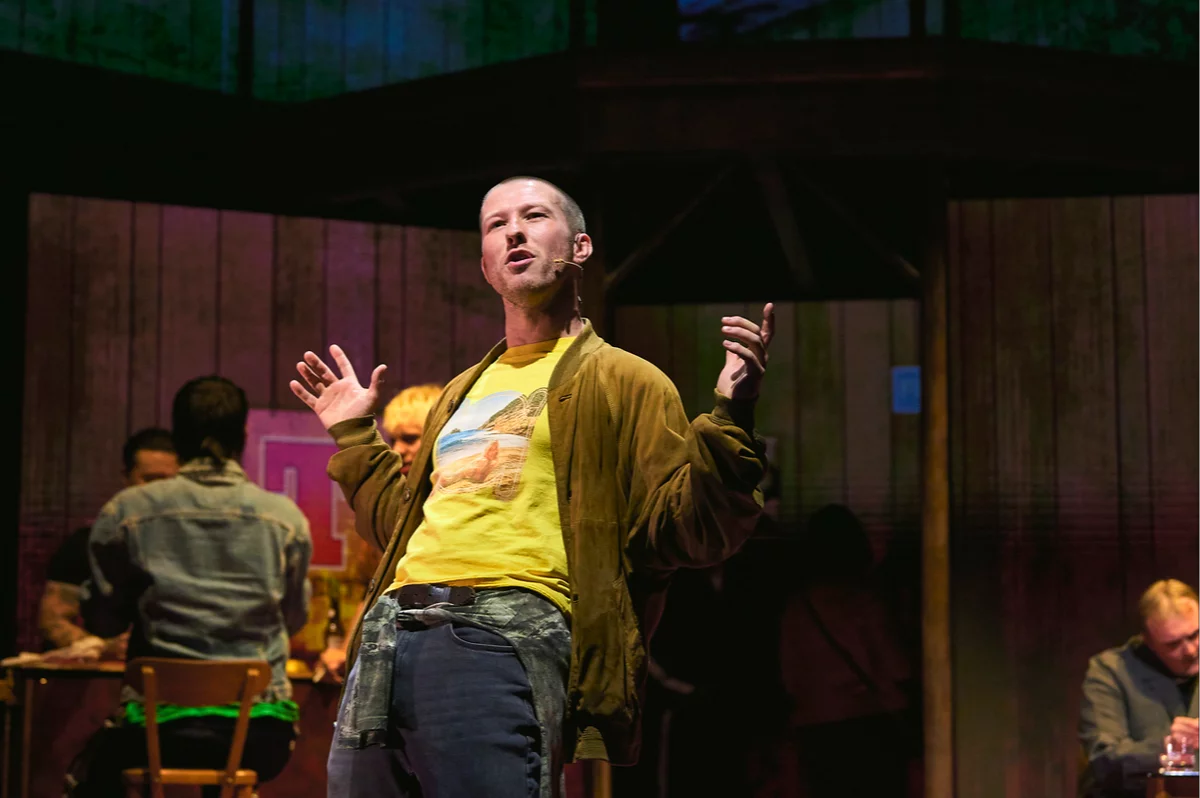
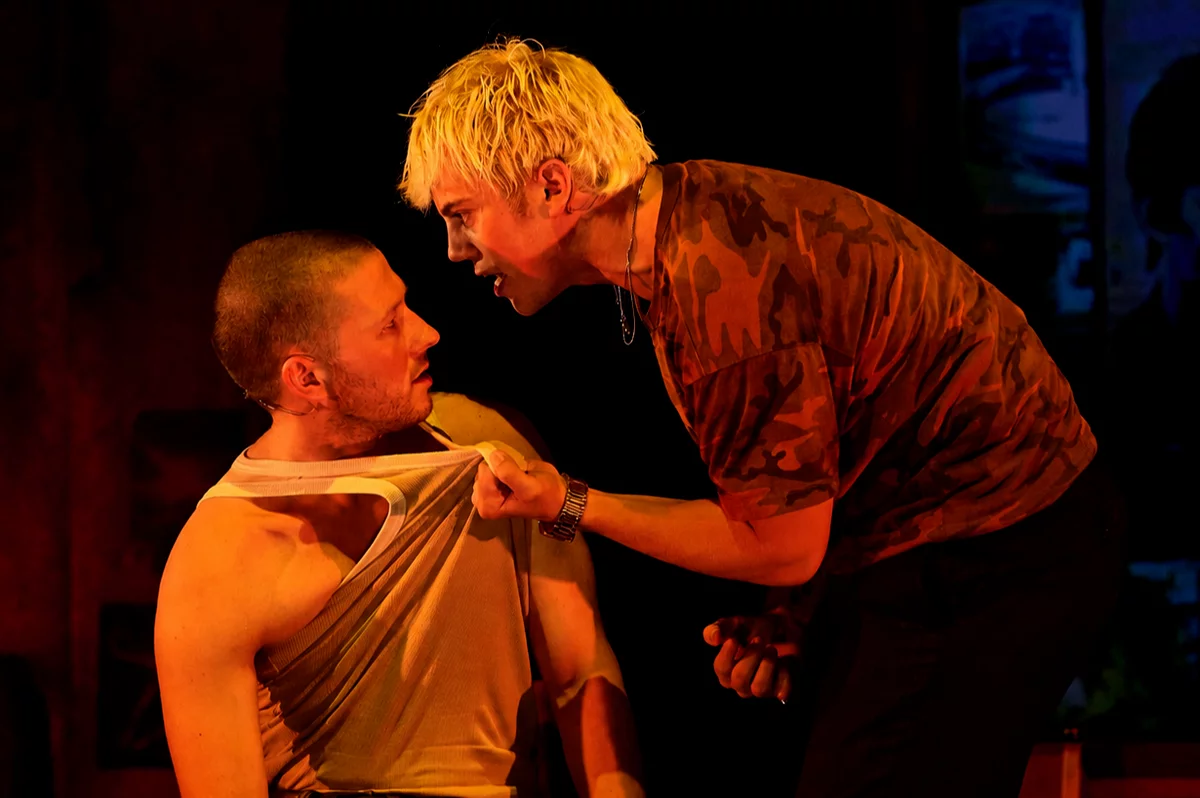
Lewis Kidd plays the lead role, having stepped up from the ensemble after the original Renton, Robbie Scott (who will be performing the role on tour), was injured during rehearsals. Kidd does an admirable job in the role, particularly at such short notice, and is energetic and cheeky, bouncing off other characters well, particularly Sickboy (Sheridan Townsley) and Spud.
Rosie Dignan gives a strong performance as Alison, a single mother who sinks further into depression and drugs following the loss of her mum, and many of the night’s most moving moments centred around her character. Dignan makes her West End and professional stage debut in Trainspotting – and judging from this performance, her career will definitely be one to watch. Tommy’s storyline was also incredibly moving, with Finlay Paul showing Tommy’s decline from happy-go-lucky footy-mad lad to one of the show’s more tragic figures with an understated, devastating performance.
The stand-out performance, however, was delivered by Kieran Andrew as Spud, also making his West End debut. Andrew’s OTT ticc-y physicality could feel like a rehash of Ewen Bremner’s performance from the film, but his masterful comedic timing and pitch-perfect delivery make the role his own. Andrew is hilarious, with highlights including Spud’s speed-fuelled monologue at a job interview, a riotously meta moment where Spud flags that he knows he’s in a musical, and of course the infamous scene with the bedsheets.
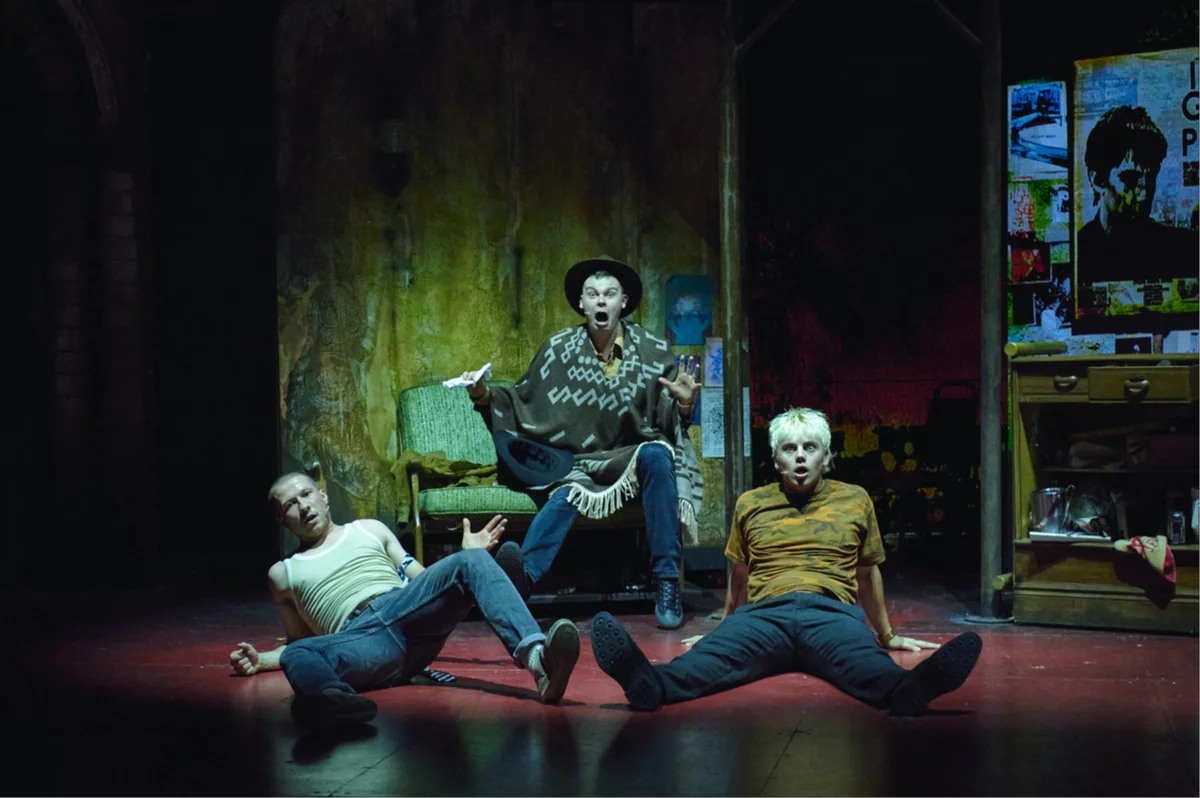
The show’s ensemble feel a little underused, though they deliver gorgeous harmonies and tight choreo when called upon. An off-stage singer, Melanie Marshall, is featured as part of the band, tucked behind a ‘back of the club’ door on stage, and while Marshall’s role is credited as The Call of Heroin, this didn’t really translate, with the choice to keep her off-stage making her impressive vocals feel like just another voice in the crowd.
The sparsely populated set, designed by Colin Richmond, is comprised of two levels: an open lower level, with pillars that recall scaffolding in the centre, propping up a small upper level balcony, and a backdrop of screens on both levels. The set is used well throughout, with a bar wheeled on to evoke the social club and the simplistic introduction of chairs or blankets serving as the bleak drug dens the characters find themselves in, but the screens felt a little underutilised (barring during one iconic scene), mostly displaying a vague city view under a grimily abstract colour palette. Characters frequently talk about the deprivation of Leith, and how they feel they have no escape other than drugs, and the screens could have been used to better effect, with less stylisation, to give a greater sense of the urban poverty that motivates the characters.
Anyone who has seen the film will have that specific toilet scene burned into their mind, and this is one of the show’s best moments, with Kidd evoking the disgusting toilet and Renton’s ‘swim’ through its depths through expertly delivered monologue and physicality. Here the screens are used to their full potential, displaying a video of Kidd swirling dreamily underwater.
The script, adapted by Welsh himself, is a mish-mash adaptation of both film (which had an adapted screenplay by John Hodge and was directed by Danny Boyle) and novel, and seems to expect that the audience has seen or read either one or both of these source materials. Scenes unfold at a break-neck pace, jumping forward quickly, echoing the novel’s non-linear structure, while folding in some references from the film without fully explaining them, which may be confusing for an unfamiliar viewer. Hopping around so fast does sometimes make the characters’ struggles with addiction feel underplayed, with the push and pull between trying to get clean and relapsing slightly lost. The toilet scene, while beautifully executed, is moved to the second half of the show instead of early on in Renton’s story, muddying the waters (pun not intended) as to where Renton is in his journey of trying to kick his habit. The scenes that are most effective – Tommy and Allison’s stories – feel well-seeded from the beginning, and allow us to sit in the moment instead of racing ahead.
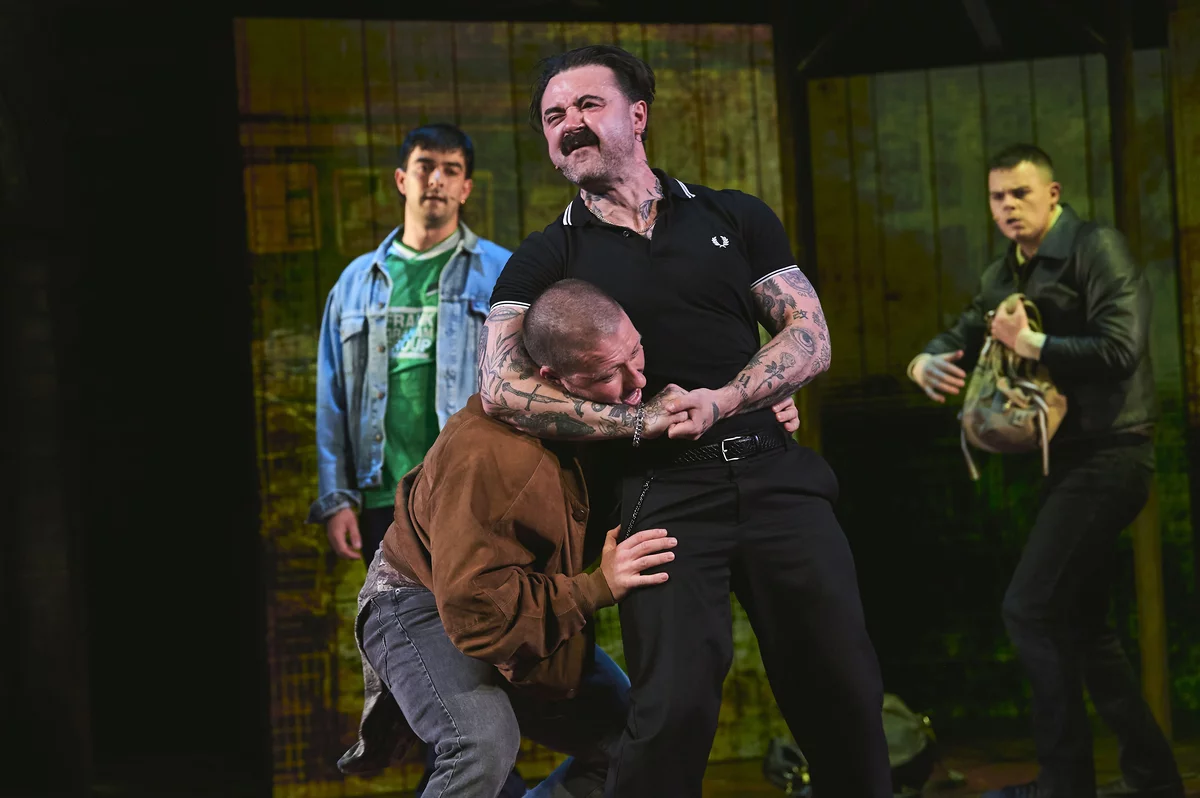
The musical also brings Renton’s family more to the forefront, and reintroduces the novel’s storyline around his brother, which was cut from the film, a choice that doesn’t fully work. Renton’s parents (McKinnis, alongside Gordon Cooper as Dave Renton) seem to exist solely to deliver exposition about Thatcher’s dismantling of the shipbuilding industry in Leith, or offer excuses for why Renton has a drug habit. This takes away some of the agency from a character who, as per the opening monologue, makes bad choices simply because he can, making his motivations a little watered down, and less interesting. Begbie (Frankie O’Connor) feels similarly diluted, and while O’Connor delivers his lines with shouty aplomb, some of the character’s psychotic nature is lost; at one point, he even comes across as the most reasonable character on stage. Because of this, the theme that everyone is using something for escapism, whether that be drugs, alcohol, or violence, also doesn’t land as hard as it might, and some of the grit of the source material is lost.
Welsh removes the character of Diane, probably the most contentious plot line from both the novel and film, which feels like the safer move in 2026, and also makes a valiant attempt to give the women in the story more to do, which doesn’t quite pay off. Cathy mainly bemoans the fact that her son is too sensitive for this world, but will always be her little boy, in a slightly dragging (but beautifully sung) number and reprise that feels, again, more like it offers excuses for Renton’s addiction. Kelly’s (played by Yana Harris) plotline also fizzles out, and her main number – a cover of “Drop Dead Gorgeous” by Republica – while energetically performed, feels tonally out of place. Alison’s storyline, however, is a highlight which feels expanded from the original, and is very affecting.
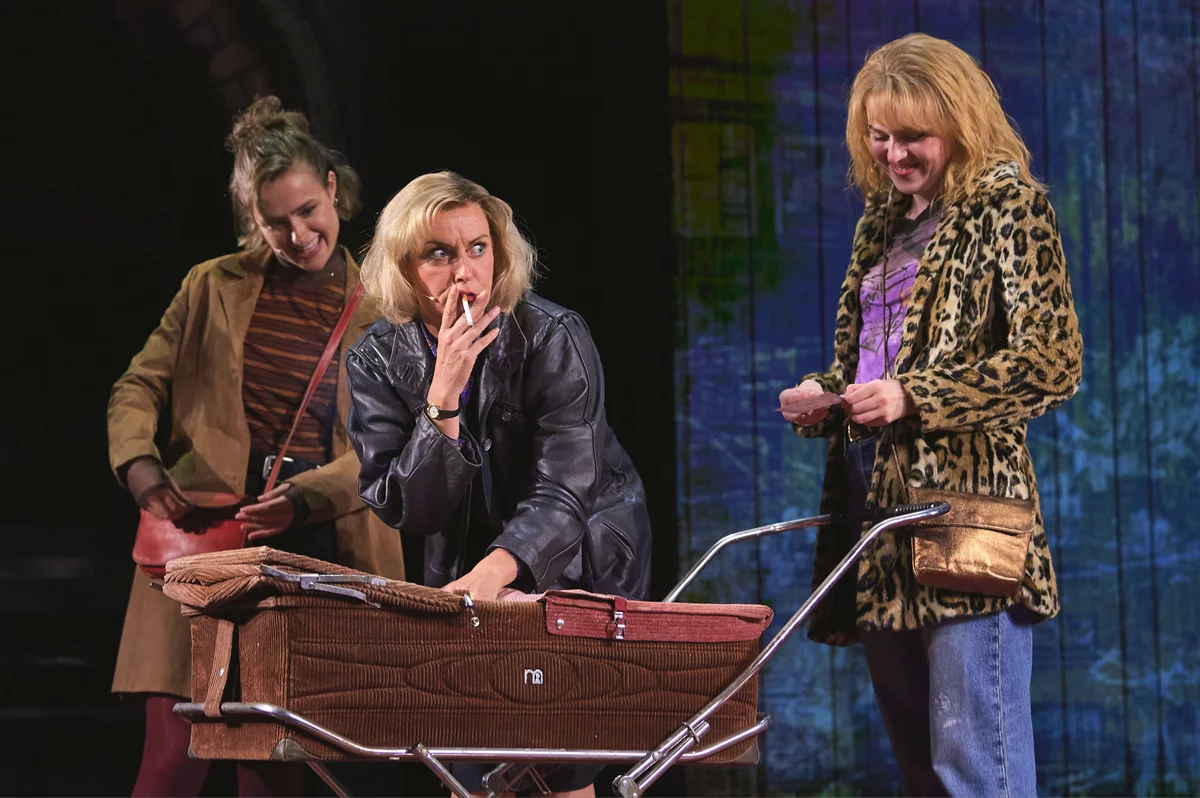
The show’s ‘a little of both’ approach to adaptation also transfers over to the songs – the musical is neither a jukebox musical nor wholly an original musical – and the original musical numbers suffer a bit of an identity crisis. Audiences might be expecting these new songs, co-written by Welsh and dance legend Stephen McGuinnes aka Steve Mac, to resemble the nineties bangers on the film’s critically acclaimed soundtrack. Sadly, the original songs weren’t particularly memorable and sometimes felt as though they slowed down the action.
The musical style of many of the new songs felt at odds with the show’s core themes and its setting, with a couple of songs bizarrely taking inspiration from country and western and evangelical music – complete with cartoon cowboys blasting across the screens, fringe jackets, and line-dancing choreo.
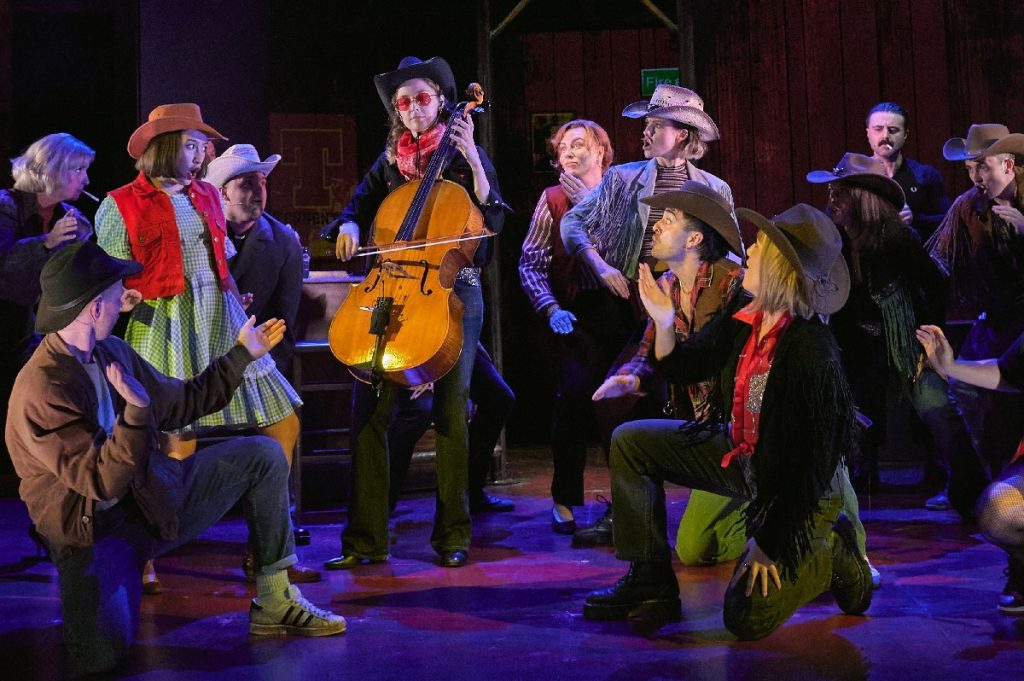
Trainspotting the Musical changes a visit to London to see Iggy Pop to a trip to Blackpool for a Northern Soul night, so it felt strange that this baked-in influence was passed over in favour of a more Americanised genre. However, a song set during Renton’s withdrawals successfully moves the story forward, and the strongest original songs were cheeky duets between Sickboy and Renton, and Renton and Spud’s comedic fourth-wall-breaking song early in Act One.
The show’s best musical moments all involved pre-existing songs, recontextualised. Lou Reed’s “Perfect Day” is used in a tragically ironic and deeply moving scene that was a true highlight; a real departure from how it’s used in the film, but equally as effective. Similarly, “Mad World” by Tears for Fears is beautifully done, featuring stunning harmonies from the whole ensemble, which left me feeling that the show might be stronger as a whole had it committed itself to being a true jukebox musical. There are some big omissions of songs from the film soundtrack, such as “Born Slippy.NUXX” by Underworld, and while this is presumably due to rights issues, their exclusion is felt. Both “Drop Dead Gorgeous” and “Mad World” are songs that were added to the musical that were not on the original soundtrack, and more period-specific songs that fit the tone and themes of the musical could have been used to great effect. The marketing for the musical offers up nostalgia, which it only half delivers.
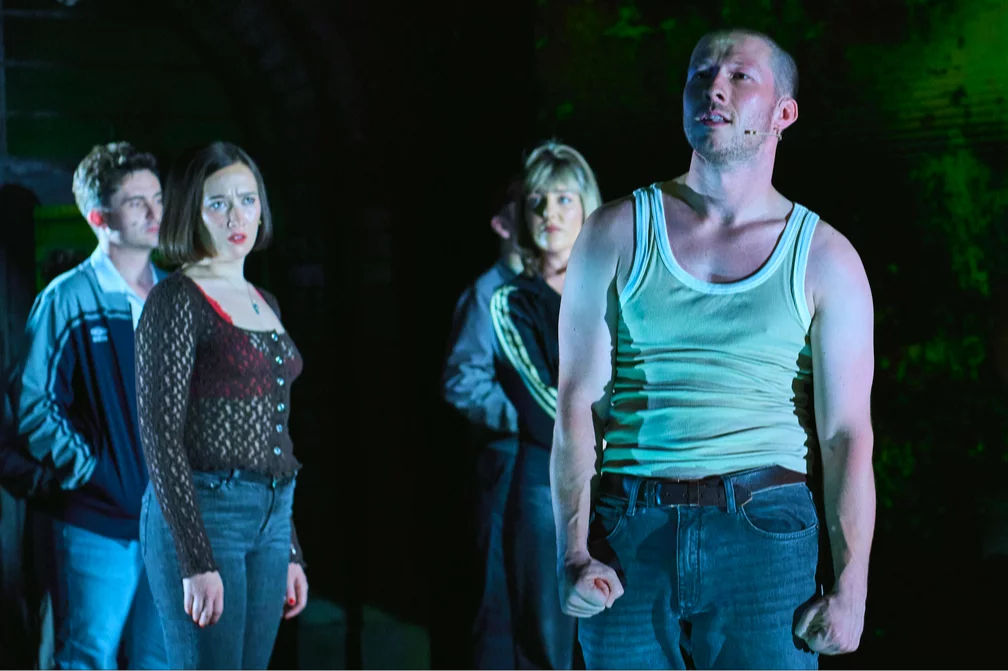
Overall, Trainspotting was an adaptation that feels like it doesn’t quite know what it wants to be. Both self-referential and trying to tread its own path, appealing to nostalgia and shying away from it. Despite some issues, the story is still compelling (there’s a reason it’s been a cult classic for over 30 years!), and the musical is never boring. Strong performances from the whole cast, alongside scenes such as the “Perfect Day” number, the worst toilet in Scotland, and Spud’s job interview, still make this slightly mixed bag worth a watch. Trainspotting the Musical takes an ambitious chance on trying something different with this new iteration, which is more than can be said for some shows – it just may not have been crying out for another adaptation in the first place.
Trainspotting the Musical plays at the Theatre Royal Haymarket until 5 September 2026.
Where I sat
For this performance, I sat in the Royal Circle E22. This seat was slightly to the side of the circle, but had a good view of most of the stage – there were just a couple of moments downstage right that were cut off (due to me not sitting up straight), and to the far right-hand side. This seat is on an aisle, which means there’s excellent leg room, and was decently comfortable. Overall, I’d book this seat again.
Have you seen Trainspotting the Musical?
Have you seen the show? Was your visit to the theatre a “Perfect Day” or more of a bad trip? Let us know your thoughts, and whether you agree with our rating, in the comments below.
Comments